More renewable energy isn’t enough
By Rory Tuke
Australia has become extremely good at generating renewable electricity. One of the best in the world per capita.
One in three Australian homes has rooftop solar. Across the country, renewable sources supplied 39.5% of electricity generation in 2025, led by solar, wind and hydro. In the National Electricity Market, renewables are already approaching half of annual electricity demand.
That is a huge achievement. But it also creates a new problem.
The next stage of the energy transition cannot be solved by only building more solar panels and wind turbines.
The next unit of renewable electricity we generate will be less valuable unless the system can move it, store it and dispatch it when consumers need it.
Australia is moving from the generation phase of the energy transition into the coordination phase.
More electricity does not always mean more useful electricity
Electricity is unusual because it needs to be generated at almost the exact moment it is consumed.
Solar generates most strongly during the middle of the day. Household demand often rises later, as solar output falls and people return home, cook dinner, use heating or cooling and charge devices.
Wind does not follow the same daily pattern, but it still depends on weather conditions and may not generate when demand is highest.
This creates a timing problem, making the famous duck curve.
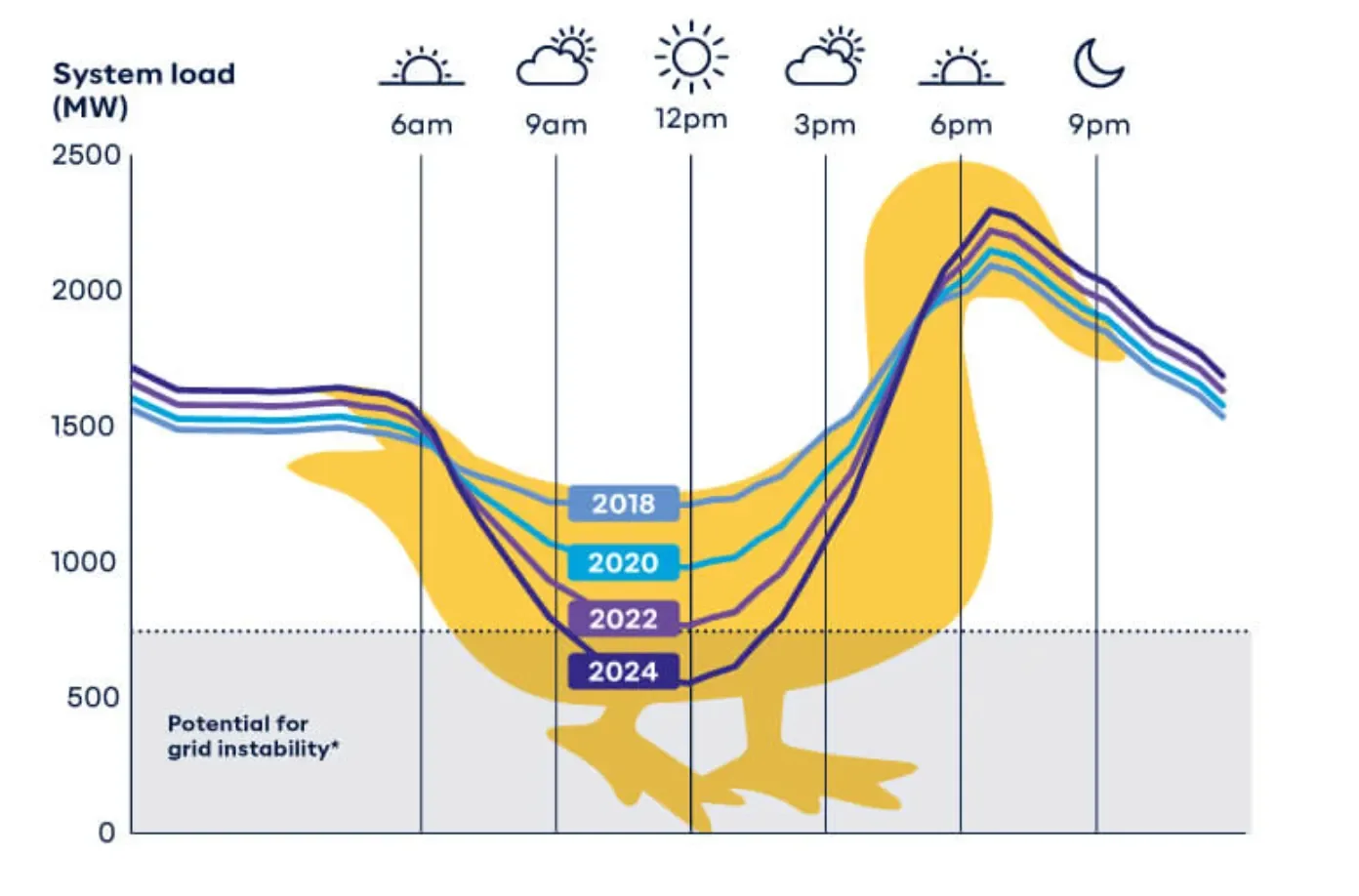
Australia can have enormous amounts of cheap renewable electricity available in the middle of the day, followed only hours later by much tighter supply conditions.
That is why wholesale electricity prices are increasingly uneven.
Renewable output can push prices very low or even negative when supply is abundant. But when output falls and flexible supply is limited, prices can rise sharply.
This does not mean renewables increase the average electricity price. Their low operating costs usually push prices down.
The more important point is that renewables change when electricity is valuable.
A megawatt-hour generated during a period of excess solar is not worth the same as a megawatt-hour available during the evening peak.
The same applies to location.
A solar farm can produce electricity, but that electricity is not very useful if the transmission network cannot carry it to consumers. A battery can be full, but its system value depends on where it is connected and whether it is available when a local constraint appears.
This problem becomes more important as renewable penetration increases.
When renewable generation supplied a relatively small share of electricity, the rest of the system could absorb its variability more easily.
At much higher levels, we need far more support. The electricity system is not linear: moving from an existing 50% to 75% renewable generation can create far more than 25% more pressure on storage, network capacity and demand flexibility.
Without these supporting systems, the marginal value of additional renewable generation can fall.
The transition is a package deal, not a singular technology
This doesn't mean Australia should stop building renewable generation. We still need much more of it.
AEMO’s 2026 Integrated System Plan forecasts almost 120 GW of utility-scale wind and solar by 2050, around five times the current level. But AEMO does not describe renewables alone as the solution.
Its least-cost pathway combines renewable generation with transmission and distribution, storage and flexible gas backup as coal plants retire. AEMO also forecasts almost 50 GW of utility-scale storage and hydro, 17 GW of flexible gas generation and a 6,000-kilometre expansion of the transmission network.
This reveals an interesting caveat. The cheapest solar farm is not necessarily the cheapest electricity system.
It may be cheapest to build vast amounts of solar in the desert where land and sunlight are abundant. But the system must also pay to connect that generation, move the electricity to the cities, balance rapid changes in output, store energy for later and maintain reliability when renewable generation is low.
Australia’s challenge is therefore not choosing between renewable generation, transmission or storage.
We need all three.
The difficult question is how quickly each part can be delivered.
Renewable generation can move faster than the grid
The Clean Energy Council estimates that, after reaching financial commitment, Australian large-scale solar projects take an average of 21 months to become operational. Onshore wind projects take around 30 months, while battery projects average 23 months. These figures exclude earlier development stages such as planning and environmental assessment, but they still show that generation and storage projects can progress relatively quickly once financed.
Major transmission projects are different.
They often require long planning processes, environmental approvals, land access and construction across large distances.
This comparison can be seen in the timelines between BESS and transmission projects:
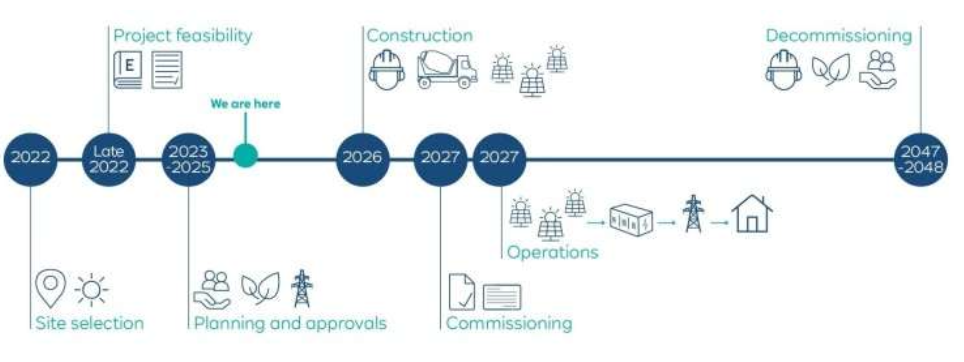
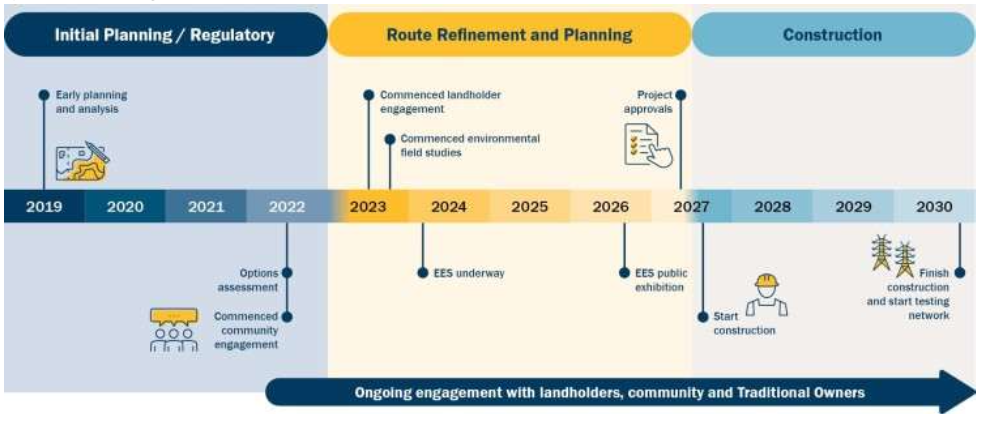
The 2026 ISP contains multiple transmission projects that are not expected to arrive until well into the 2030s.
This does not mean transmission is unnecessary or that Australia should stop building it.
AEMO estimates that new transmission in its optimal pathway would deliver $28 billion in net market benefits compared with stopping after projects already committed or anticipated. Transmission is essential and very beneficial.
But it is also expensive, politically difficult and slow.
That creates an important near-term question:
How can Australia use the network more efficiently while major transmission projects are still being delivered?
The answer may already be sitting inside hundreds of thousands of Australian homes.
The underused power station inside Australian suburbs
AEMO says around 600,000 NEM households already have batteries.
By 2050, its Step Change scenario forecasts 87 GW of rooftop and other small-scale solar supported by 35 GW and 78 GWh of consumer battery capacity. Just over half of those batteries are assumed to participate in virtual power plants. That's a lot of spare storage that isn't being utilised as well as it could be.
Individually, a household battery is simple.
It charges from rooftop solar during the day and discharges later, reducing the household’s electricity bill. That already helps the wider system by absorbing excess solar and reducing evening grid demand, filling out the 'belly' of the duck curve.
But the bigger system value appears when those batteries stop acting like isolated household devices and start acting like a coordinated fleet.
A single home battery can shift one household’s demand. One hundred batteries in the same area can change what the local network needs from the grid.
Imagine 100 homes connected through the same part of the distribution network.
On a hot evening, their combined electricity demand rises just as rooftop solar begins to disappear. If every battery operates independently, some may discharge immediately. Some may stay full as backup. Others may already be empty.
The network has no certainty about how much demand those homes will place on the feeder or local transformer.
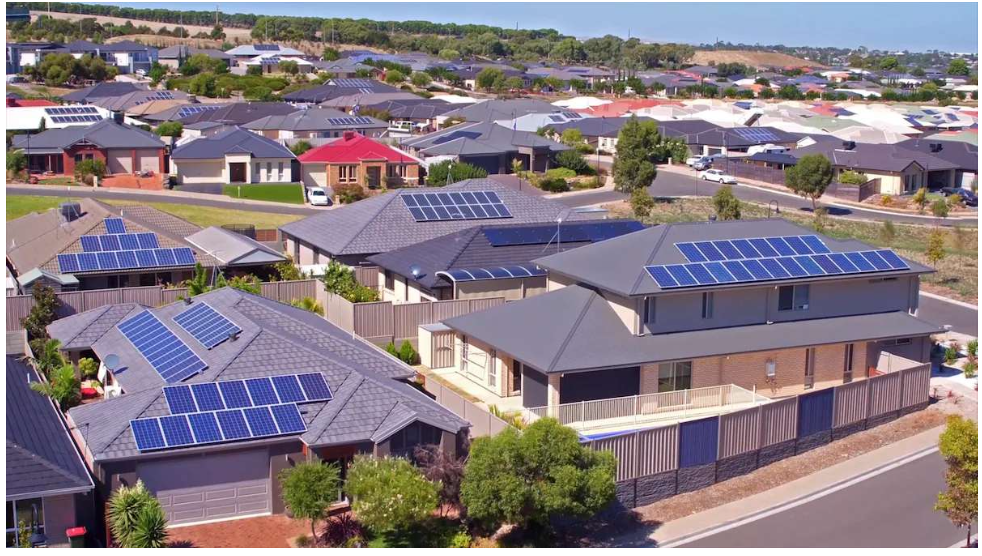
Now imagine those batteries are coordinated under rules chosen by their owners.
Each household selects a minimum reserve level. Some may keep 30% available for an outage. Others may allow more of their battery to be used in exchange for higher payments. Then the operator could report that the neighbourhood fleet has a certain amount of capacity available for the next two hours (without needing the exact state of charge of every individual household).
When batteries across the same area are coordinated, they can change the neighbourhood’s combined demand on the grid. During a hot evening peak, they can discharge together and reduce how much electricity the area needs to draw from upstream. When rooftop solar output is high and the local network is becoming congested, they can absorb more energy instead of allowing every household to export at once.
The result is a lower aggregate load on the feeder, transformer and potentially the wider system.
That may allow the network to serve more homes, electric vehicles and electrified appliances before another expensive upgrade is required.
A battery’s value depends on where it is
Two identical batteries can create very different value.
The first is located on a part of the network with plenty of spare capacity. It discharges at 6 pm because wholesale electricity prices are high, creating some value for the household and potentially the retailer.
The second is located behind a heavily loaded transformer. It discharges during the transformer’s critical annual peak and helps reduce the need for an upgrade.
A battery’s value depends not only on how much electricity it stores, but where it is connected and when it responds.
Caulfield provides a real example of what this looks like.
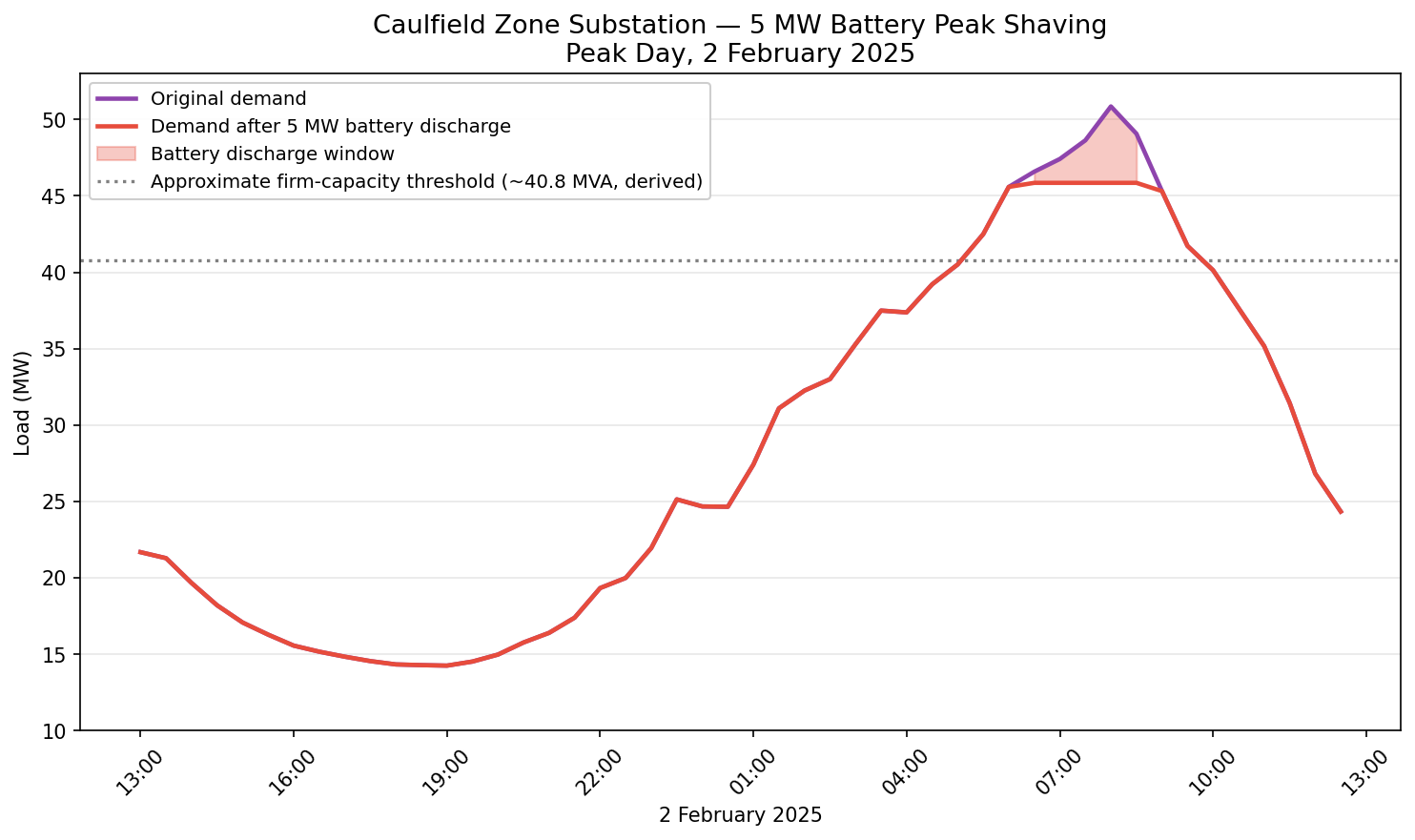
On its highest-demand day of 2024–25, load reached about 51 MW at 7 pm, after rooftop solar had fallen away but air-conditioning demand remained high. Demand then dropped rapidly over the following two hours.
The network problem was therefore not sustained high consumption across the entire day. It was a narrow evening peak.
In a simple simulation, 5 MW of coordinated battery discharge reduced that peak to about 46 MW. The battery did not need to discharge continuously. It only had to target the small number of intervals placing the substation under the greatest pressure.
This matters because networks are often upgraded to meet the highest levels of demand, even when those peaks occur for only a small number of hours each year. If coordinated batteries can reliably reduce those critical peaks, they may defer or reduce the scale of local network upgrades, allowing existing infrastructure to carry more demand before new capacity is required.
This is where location and coordination matter. The same battery operating elsewhere, or discharging earlier for wholesale arbitrage, may provide household or market value. At Caulfield, discharging during this particular peak could also help reduce pressure on the local network.
The same 5 MW of battery capacity could be far more valuable at Caulfield during this narrow peak than elsewhere at another time. The hardware is the same. Its value depends on where it is connected and when it responds.
Could this reduce network costs?
Transmission and distribution infrastructure represents a large share of the cost of supplying electricity to households, 42% NEM wide in 2020.
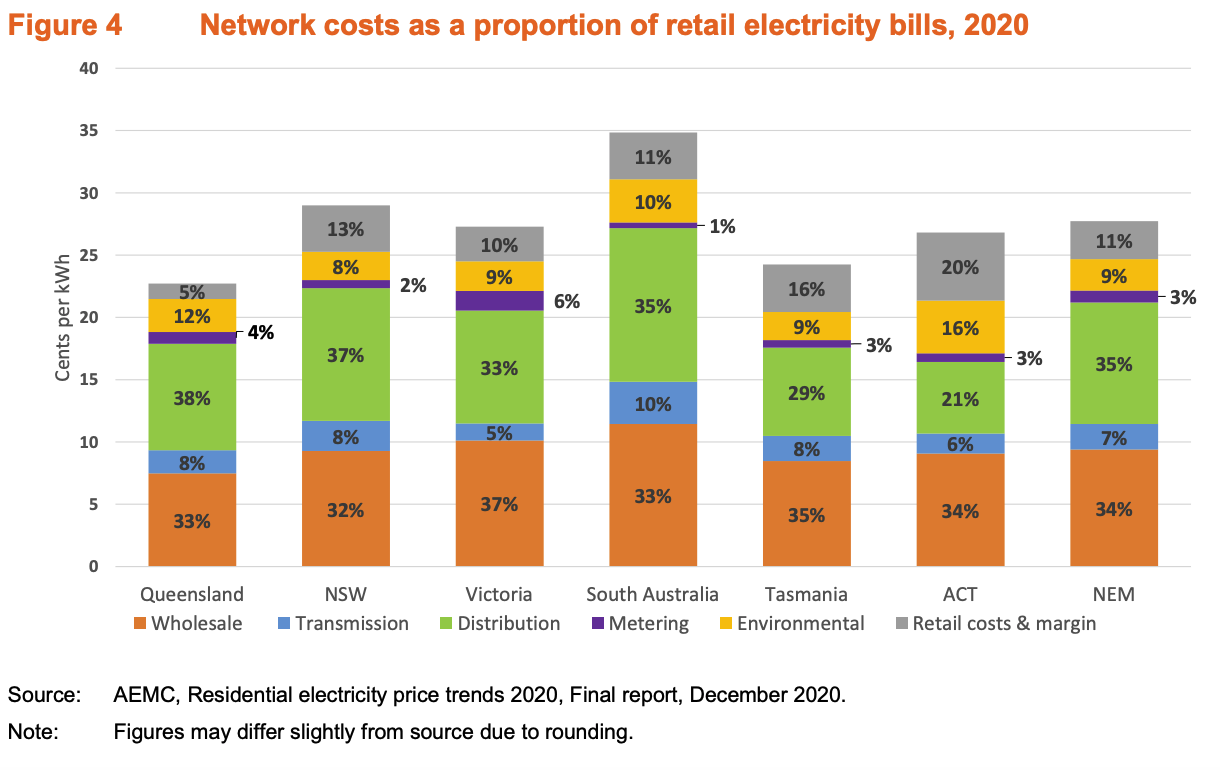
This is not to say that coordinated batteries will make that network cost disappear. The poles, wires, transformers and substations already built still need to be operated, maintained and eventually replaced. Homes with batteries also remain dependent on the grid during extended periods of low renewable output, unusually high demand or equipment failure.
But there is a targeted opportunity.
By reducing the most extreme flows at the most constrained times, coordinated batteries could delay some local upgrades, create more room for rooftop solar and electric vehicles, and make better use of infrastructure that consumers have already paid a large amount for.
AEMO’s modelling supports this broader idea. In its Step Change scenario, coordinating consumer batteries and electric vehicles reduces projected system costs by $5.2 billion. By shifting demand and making household storage available to the wider system, those resources reduce the need for some additional grid-scale investment, including up to $5 billion of utility-scale storage.
Coordinated batteries may reduce the amount of additional infrastructure required at the margins, and could provide a short-term buffer while larger projects are still under construction.
The household must remain in control
There is a problem with this idea. And it's a reason why coordinated battery programs (like VPPs) have had lower participation than expected.
Ultimately, the battery belongs to the household. The owner paid for it and set it up, so a retailer or network should not be able to drain it whenever doing so benefits the system.
This is why the most sensible model is not complete external control. It is relegated control within boundaries chosen by the owner.
A household might choose to keep at least 30% of its battery available for backup, while allowing the remaining capacity to be coordinated. In return, it should receive a clear share of any wholesale, network or grid-service value the battery creates beyond a feed in tariff.
The owner should remain in control of the arrangement. They should be able to decide how much energy is reserved for an outage, when the battery can participate, how much additional cycling is permitted and when they can opt out.
The program should also improve the household’s resilience. Before periods of extreme demand or elevated outage risk, the battery could be kept at a higher state of charge rather than emptied for market revenue. Where the home is equipped for backup operation, that reserve can keep essential appliances running if the grid fails.
Households are providing the battery, accepting additional cycling and sharing access to valuable operating data. If retailers, networks and aggregators earn revenue or avoid costs using those assets, households should receive a transparent and substantial share of that value.
Otherwise, participation will continue to remain limited.
Why is this not already happening?
Virtual power plants already operate in Australia. The harder part is making them work at scale and getting people to sign up.
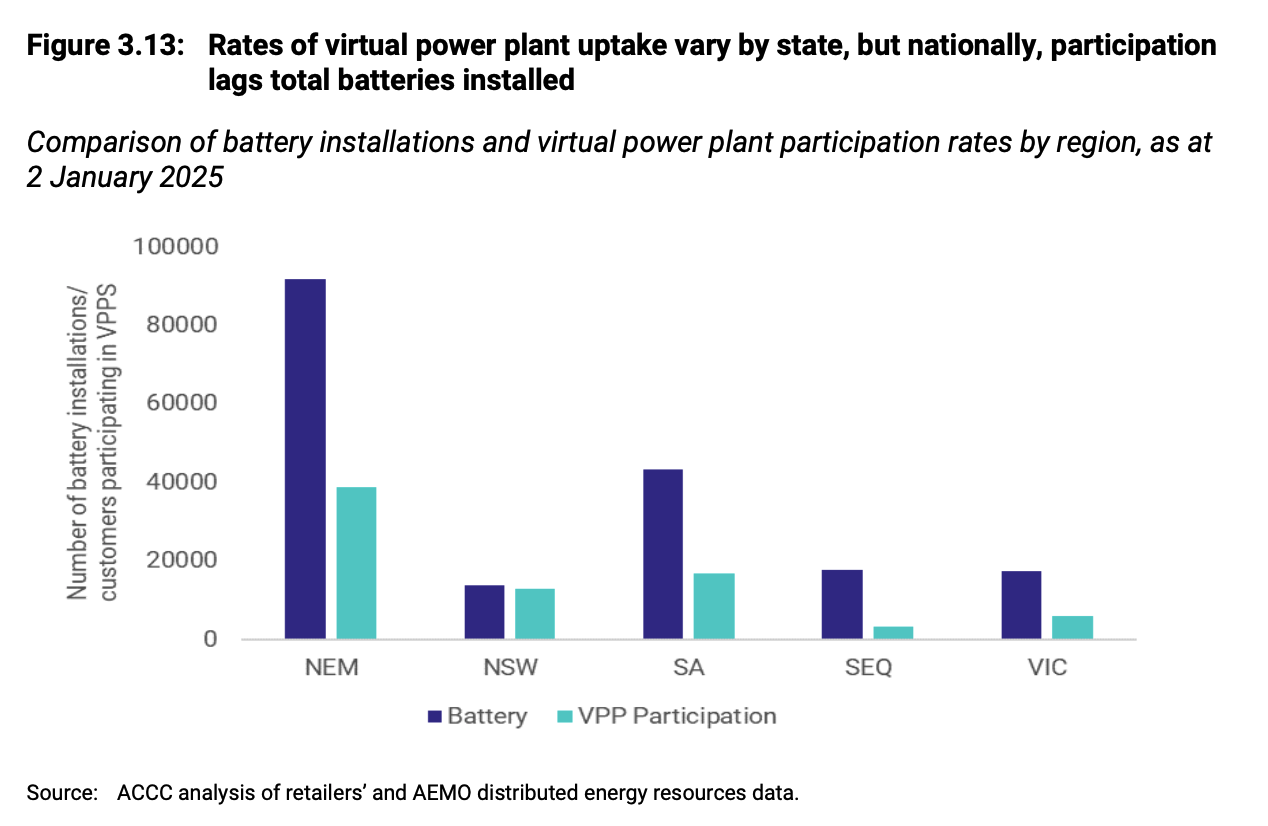
In my opinion the current incentives are just not there yet. Households receive a modest amount of around a few hundred dollars a year plus a signing bonus. It doesn't give additional value based on availability and location or give benefit to local communities. In exchange the household loses autonomy on a valuable asset they paid at least a few thousand for.
The same battery may be useful to a household, retailer, network and AEMO, but they may be focused on different goals. A household may want backup power. A retailer may want the battery during a price spike. A network may need it during a local peak. These goals do not always match up and may conflict. There are also practical barriers around software, data access, privacy and warranties. Many of these issues are not dealt with transparently.
For these reasons VPP participation will remain stagnant unless benefits are made clearer.
The key will be how to achieve a reasonable and beneficial outcome for all parties while still fairly compensating households. And how to build a better system that knows when batteries are available, where they are most useful and who should be paid for the value, they create.
The transition after generation
Australia will still need enormous investment in renewable generation, transmission, storage and network infrastructure. Coordinated household batteries will not remove that need, but they can help ensure those investments are used more efficiently and that renewable electricity is available when and where it creates the most value.
There is a real opportunity is to build a system in which everyone can all benefit from the same distributed assets. But that only works if the system is designed around the interests of everyone involved.
Households must retain meaningful control over assets they paid for and receive fair compensation for the value they provide. Retailers and networks could benefit from access to batteries when they are useful. The broader system needs coordination that directs capacity to the right place at the right time.
While coordinated household batteries may not replace the infrastructure Australia needs, if used correctly they will help the whole system deliver more renewable energy at lower cost with the value shared fairly.
About the Author
Rory is an Electrical Engineering student at Monash University with a strong interest in the future of the energy grid. He is passionate about renewable energy and finding smarter ways to use energy resources for the benefit of consumers and businesses.